 Archery Archery
Grand National Archery Society GNAS
GNAS Archery
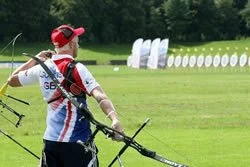 With all the talk of 2012 and the Olympics in London, it would be easy to lose sight of the fact that many people enter archery for the social side. With all the talk of 2012 and the Olympics in London, it would be easy to lose sight of the fact that many people enter archery for the social side.
"Archery is THE family sport, and some people get into it because their kids take it up, and vice versa," says Barry Eley, the performance manager of the GB national squad. "It's the one sport where everyone of all ages and abilities can line up together and take part, and that is one of it's big attractions.
"Others take up archery because they have had to stop doing other sports through injury or age, when they found, like me, that they couldn't keep up with the youngsters on the football pitch any more."
Archery in Britain is run by the sport's national governing body, the GNAS, which is based at Lilleshall, near Telford. All clubs come under the GNAS umbrella, and all members are also registered members of GNAS (membership is just under 30,000 - record levels).
The British elite squad are very competitive at international level - Alison Williamson won a bronze medal at the Athens Olympics, and reached the first ever World Cup Final last year.
But for every Alison Williamson, there are thousands of archers who take up the sport for fun. Eley says the best advice he can give a novice is to enrol on a beginners course at a recognised local club. "Apart from learning archery, safety and etiquette are also very important, and our coaches guide all beginners on such issues," he said.
And if you want to be good enough to compete in competitions, rather than just shoot socially? "Make sure you put as much effort into your general strength and conditioning as you do to your archery practice, to prevent injuries and ensure you can handle your bow efficiently through out practice and events," he said.
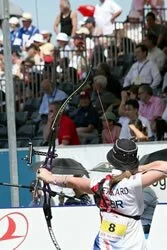 "But do be careful before you start doing archery regularly. Many people will take up the sport as they don’t have to run or keep fit, but in order to shoot any bow you need to have the muscle strength in the upper and lower body. Ignoring general fitness and not keeping your muscles toned can lead to injuries around the shoulder and collar joints. Incorrect shooting technique can lead to wrist and finger joints and ligaments being inflamed and sore. "But do be careful before you start doing archery regularly. Many people will take up the sport as they don’t have to run or keep fit, but in order to shoot any bow you need to have the muscle strength in the upper and lower body. Ignoring general fitness and not keeping your muscles toned can lead to injuries around the shoulder and collar joints. Incorrect shooting technique can lead to wrist and finger joints and ligaments being inflamed and sore.
The essential equipment to become an archer is a bow, arrows, a chest guard and a finger guard. Says Eley: "Like all sports, these can cost from as little as £60 for a starter kit, to up to £3000 for the Olympic archers equipment.
"When you do a beginners course - normally six one hour lessons - your club coach will ensure you get exactly what you need, and advise accordingly, as all equipment should fit the archers size and strength, and not be just what a salesman would sell you - thought most retailers work with local clubs, and the GNAS and would tell you to join a club first anyway."
The rules and etiquette of archery make it as safe a sport as there is. Says Eley: "It's safe because every one in the sport has to abide by the rules. My best tip is to enjoy yourself, and be considerate of your fellow club members. You'll make lots of friends, and you'll find everyone is very helpful."
The GNAS website (www.gnas.org) list all the clubs throughout the country, so you can look for one in any given area. And if you do not see one, then ring the GNAS office on 01952 677888. The website has links to clubs, counties and regions, the archery in schools association plus other sites you either want or need to visit. Technical information can be found in several sections on the site particularly in the performance section. Failling that, contact Peter Jones, GNAS media, on 07841 997408.
|


