 British Fencing British Fencing
Fencing
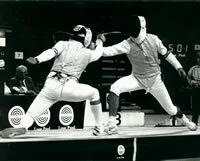 Fencing is the European martial art, offering a physical and mental challenge with a touch of glamour. It combines speed and fitness with the need to be completely focussed on out-thinking your opponent. Because of this emphasis on speed and skill rather than brute strength, fencing is a good sport for women as well as men. It has been part of the Olympic Games since their revival in 1896. Fencing is the European martial art, offering a physical and mental challenge with a touch of glamour. It combines speed and fitness with the need to be completely focussed on out-thinking your opponent. Because of this emphasis on speed and skill rather than brute strength, fencing is a good sport for women as well as men. It has been part of the Olympic Games since their revival in 1896.
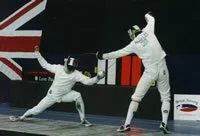 The origins of modern fencing date from the 16th century when the rapier became an item of fashion among the nobility. The first sporting fencing weapon was the foil, which was introduced in mid-17th century France. Its rules, which restrict valid hits to the trunk of the body, were developed to allow the skills of swordplay to be demonstrated in safety. The origins of modern fencing date from the 16th century when the rapier became an item of fashion among the nobility. The first sporting fencing weapon was the foil, which was introduced in mid-17th century France. Its rules, which restrict valid hits to the trunk of the body, were developed to allow the skills of swordplay to be demonstrated in safety.
Until the invention of the wire mask in the mid-18th century, fencing was a rather static exercise, with fencers taking it in turns to make attacks. Masks changed this, allowing the instant parry-riposte and a much more mobile style of fencing.
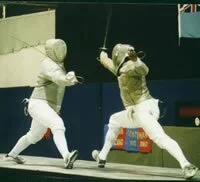 Epée, the second fencing weapon, was introduced in France in the 1860s as a reaction against the artificial conventions of foil. It was intended to recreate the conditions of a duel as closely as possible and the target is any part of the body. Epée, the second fencing weapon, was introduced in France in the 1860s as a reaction against the artificial conventions of foil. It was intended to recreate the conditions of a duel as closely as possible and the target is any part of the body.
The third fencing weapon, sabre, is derived from the cavalry sword. In the late 19th century an Italian fencing master developed a lightweight fencing sabre that could be manipulated with the speed and accuracy of a foil and was fought under similar rules.
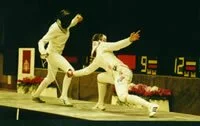 Today all three weapons are fenced with electric equipment that is used to indicate the arrival and validity of hits. At foil and sabre, valid hits are restricted to a target area covered by a conductive metallic over-jacket, plus the mask for sabre. The rest of the kit is comfortable and looks good too: close-fitting white jacket and breeches, white socks and special trainers. Today all three weapons are fenced with electric equipment that is used to indicate the arrival and validity of hits. At foil and sabre, valid hits are restricted to a target area covered by a conductive metallic over-jacket, plus the mask for sabre. The rest of the kit is comfortable and looks good too: close-fitting white jacket and breeches, white socks and special trainers.
There are around 10,000 fencers in the UK and over 400 fencing clubs affiliated to the British Fencing Association.
Visit our British Fencing website.
|


