 The British Horseball Association The British Horseball Association
Horseball in the UK
WHAT IS HORSEBALL
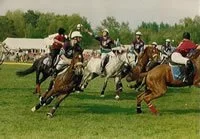 Horseball is the latest British equestrian sport, recently imported from France. This highly spectacular game has been compared to a cross between rugby and basketball on horseback and was invented by Jean-Paul Depons, a former riding instructor and rugby player. The game was created as an excercise to improve skill and discipline between horse and rider. Several concepts were developed by the French Equestrian Federation, but only horseball proved successful and, since its introduction, has become a discipline in its own right. Horseball is the latest British equestrian sport, recently imported from France. This highly spectacular game has been compared to a cross between rugby and basketball on horseback and was invented by Jean-Paul Depons, a former riding instructor and rugby player. The game was created as an excercise to improve skill and discipline between horse and rider. Several concepts were developed by the French Equestrian Federation, but only horseball proved successful and, since its introduction, has become a discipline in its own right.
The game is played on a fairly small pitch and involves sudden spurts, rapid stops, half turns and acceleration, therefore horses must be well schooled and under perfect control. Riders must be reasonably experienced and confident.
Despite the speed and physical nature of the game it is fun to play and it is safe, and our Association aims to keep it that way.
PRINCIPLES OF THE GAME
1. The Game
Two teams oppose each other. They are required to gain possession of a ball, especially fitted with 6 leather handless, pass it at least three times within the teams as they race towards the goals and score by shooting through the a hoop (1 metre in diameter) suspended on a 3.5 metre poles. It is essentially a team game and any member can score. At no time may the riders dismount, but passes may go forwards or backwards and can be as short or as long as the opponents permit. Speed is of essence.
 2. The Teams 2. The Teams
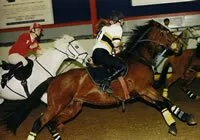
Each team is composed of 6 riders and horses. Only 4 from each team are allowed on the field at the same time, but substitutions are allowed during the match.
3. The Ball
This is a junior football (size 4) enclosed in a harness fitted with 6 leather handles.
4. The Match
There are two halves, each of 10 minutes, with half time of 3 minutes. It is umpired by 2 referees, one on horseback and the other on a chair at the side of the pitch.
THE MAIN RULES OF HORSEBALL
a. The team scoring the greatest number of goals wins the match.
b. Before the goal is allowed the ball must be passed consecutively through the hands of at least 3 of the 4 members of the team. At least 3 passes must be made without dropping the ball before a goal can be scored by shooting through the hoop.
c. The ball must not be retained by any player for more than 10 Seconds.
d. After a goal the game is restarted with a throw-in similar to those on rugby. Two players from each team form a line out (at least 5 metres from the sideline). The side with the advantage throws in the ball.
e. If the ball or a player carrying the ball or the ball goes out of play on the side
lines, the opposing team takes possession and the game restarts with a simple
penalty.
f. There are three forms of penalty depending on the level of infringement.
g. All the rules are designed for the safety of horses.
THE BACKGROUND OF HORSEBALL
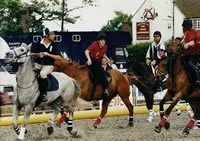 Some 20 years ago the French Equestrian Federation were looking for something to develop riding skills that could be used in a Manége, would be fun to do and easy to learn. Some 20 years ago the French Equestrian Federation were looking for something to develop riding skills that could be used in a Manége, would be fun to do and easy to learn.
Jean Paul Depons, a riding instructor and a rugby player came up with the concept of HORSEBALL which despite it’s English name was invented at Castillion near Bordeaux.
Horseball has become an integral part of the riding instruction in France, and the federation is energetically promoting it at home and, more recently, abroad. The country now boasts some 450 horseball clubs, which compete in national and regional leagues. France has won the European Cup on each of the occasions it has been contested so far, including this year.
Elsewhere, progress has been slower, although it is now gathering pace. Portugal and Belgium have the strongest teams after the French and the most players. The game has grown in England during the last five years since the French introduced it in an exhibition tournament at the Horse of the Year Show in 1990 and it is also starting to win converts outside Europe, including Australia, parts of the Middle East and the Americas.
The game has now been recognised by the International Equestrian Federation, which is considering including it as a core discipline. Leading horseballers reckon this could pave the way for eventual Olympic recognition.
The Game
Horseball pits four players (who can be of either sex) against each other. They compete in halves of 10 minutes each- enough to tire both horses and riders-on a pitch that is no more than 70 metres by 30 metres. The smallness of the pitch ensures that players are always in close contact, much as in the forward play in rugby and in contrast to polo in which excessive space limits thrills to short bursts. The aim of the game is to win the ball (a small football, fitted with six leather handles); make a minimum of three consecutive passes of the ball (forward as well as backwards, unlike in rugby) between at least three team-members, without dropping it, and to shoot it through a hoop 1 metre in diameter and 3.5 metres off the ground.
In a game of reasonable quality, the teams would expect to share perhaps 15 goals. After each score, or if the ball goes out of play, play restarts with a line-out contested by two players from each side. This is one of the clearest opportunities to gain control of the ball, so teams work hard on tactics to help win on their own throw in, as in rugby. Otherwise, possession changes either in the tackle or when the ball goes to ground. (There are no scrums, alas!.)
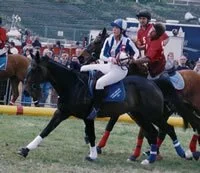 Tackling usually involves physical contact, though technically a player must grab the ball without grabbing its carrier. The carrier must hold the ball in one hand only while being tackled, but a challenge can often be evaded simply by holding the ball on the side away from the tackler. Effective tacklers overcome this by shoulder-barging the carrier to knock him/her off balance, at which point his natural instinct is to steady himself by pulling in the extended ball-carrying arm, giving the tackler a chance. When the ball is dropped the player has to slide from the saddle and sweep it up, connected to his charging steed only by the stirrups that are connected by a belly strap – an act that requires much courage and is thrilling to watch, especially when two opponents race side-by-side to win the ball. Tackling usually involves physical contact, though technically a player must grab the ball without grabbing its carrier. The carrier must hold the ball in one hand only while being tackled, but a challenge can often be evaded simply by holding the ball on the side away from the tackler. Effective tacklers overcome this by shoulder-barging the carrier to knock him/her off balance, at which point his natural instinct is to steady himself by pulling in the extended ball-carrying arm, giving the tackler a chance. When the ball is dropped the player has to slide from the saddle and sweep it up, connected to his charging steed only by the stirrups that are connected by a belly strap – an act that requires much courage and is thrilling to watch, especially when two opponents race side-by-side to win the ball.
Apart from lineouts, tactics are mostly about attack. Passing the ball within a loose diamond formation is the best option. If the attackers ride to closely together, defenders can force them as a pack away from the goal, if they are too spread out, interceptions become easy as they do if the diamond collapses into a straight line across the width of the pitch. But, ultimately, games are won by superior horsemanship. A horseballer must keep his hands free, and rely almost entirely on his legs to control his mount-to stop, turn and vary it’s speed. This, say horseballers requires more skill than polo, in which players rely on reins and a whip.
British Horseball
The English league is currently expanding and has over two hundred members. This comprises of a senior and junior league.
European Teams
The European teams include the following nationalities;
France
Italy
Belgium
Portugal
Great Britain
Spain
Austria
Germany
Visit our website: British Horseball Association
|