 British Petanque Federation British Petanque Federation
Petanque
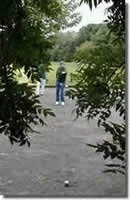 Two balls and a jack were unearthed in the sarcophagus of an Egyptian Prince of the 52nd Century B.C. Thus there is archaeological evidence that a form of pétanque was played over seventy centuries ago. Subsequently there have been historical references in both France and England at the time of Edward the Third and Elizabeth the First. What else could Drake have played on the Hoe at Plymouth? It is fact that a game played with cannon balls the size of cricket balls, was very popular with both soldiers and sailors at that time. In 1910 a new version was developed in the small town of La Ciotat, near Marseilles. Interestingly it was adapted from a similar game of the time to enable a handicapped player to participate. It is this version that has become the standard throughout the world played to a set of internationally recognised rules. Two balls and a jack were unearthed in the sarcophagus of an Egyptian Prince of the 52nd Century B.C. Thus there is archaeological evidence that a form of pétanque was played over seventy centuries ago. Subsequently there have been historical references in both France and England at the time of Edward the Third and Elizabeth the First. What else could Drake have played on the Hoe at Plymouth? It is fact that a game played with cannon balls the size of cricket balls, was very popular with both soldiers and sailors at that time. In 1910 a new version was developed in the small town of La Ciotat, near Marseilles. Interestingly it was adapted from a similar game of the time to enable a handicapped player to participate. It is this version that has become the standard throughout the world played to a set of internationally recognised rules.
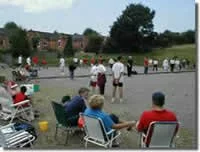 Pétanque is played throughout the British Isles. It is a sport for all ages and both sexes, it is classless and can be played wherever a reasonable surface can be found or created. Pétanque is played throughout the British Isles. It is a sport for all ages and both sexes, it is classless and can be played wherever a reasonable surface can be found or created.
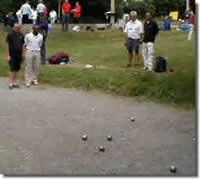
The concept of the game of pétanque is simple and similar to bowls, i.e. resting your boule closer to the jack than your opponent. However, instead of rolling wooden bowls over an immaculately maintained lawn, pétanque is played on an easily maintained area of fairly level 'rough' ground, with metal boule rolled or tossed to the jack.
The sport has seen the biggest changes in its organisation and structure for thirty years with the recent formation of the British Pétanque Federation. The Federation is the successor to the long-established British Pétanque Association.
Newly elected President of the Federation, Cardiff solicitor Dan Murphy, explained, “With political changes such as devolution and new approaches by government to funding sport in the UK, it became apparent a few years ago that the structure of the British Pétanque Association was no longer able to deliver a modern and effective organisation for the sport in Britain.
 After much soul searching and consideration, a vote of all the members in Britain took place during the summer, at which there was a huge majority in favour of the changes, which have now come into effect. After much soul searching and consideration, a vote of all the members in Britain took place during the summer, at which there was a huge majority in favour of the changes, which have now come into effect.
The core of these changes involves the establishment of national associations for England and the Channel Islands, Scotland and Wales. These allow the players direct control over their sport in their own areas and at the same time allow the national associations much better access to a variety of sports funding.
The provision of teams, at all levels, to represent Great Britain in international competitions will now be handled by the Federation, so relieving the national associations of a burden and responsibility – a burden which had begun to distort the structure and finances of the old BPA.
It is intended that the Federation will be more vigorous and effective in gaining support for the sport and helping the national associations to see an expansion of the sport in Britain. It will also provide sponsors with much better opportunities to support the sport.
The Federation’s headquarters have moved from Coventry to Cardiff. This is appropriate in that in recent years, South Wales has seen a significant increase in interest in the sport. In 2000 the first ever home nations championship between England, Scotland, Ireland and Wales took place at the Millennium Stadium in Cardiff. Since then there have been a number of high profile events in Cardiff and Cwmbran. In 2005, Cardiff will be the venue for several qualifying competitions for entry into the Great Britain teams and is also the location of the International North Sea Pétanque Tournament.
These championships involve seven countries bordering the North Sea and will see over 200 of the best players in Europe competing. The event will take place at a time when Cardiff celebrates 100 years as a city and 50 years as a capital city.”
Visit the British Petanque website.
|


