The Hurlingham Polo Association The Hurlingham Polo Association
HOW TO START POLO
WHAT IS POLO?
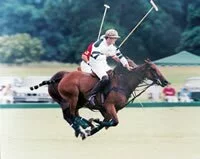 The fastest ball sport in the world, it is played with four men on horses to a team. A ball is hit with a stick towards the goal, one at each end of a 300 yard long by 160 yard wide field. A game consists of 4 to 6 periods called chukkas, a chukka is 7 minutes long. Teams change ends each time a goal is scored. It can be played by men and women of any standard. The handicap system goes from -2 at the bottom to the very best at 10. In handicap tournaments the number of goals start is obtained by multiplying the difference between the two teams' total handicaps by the number of chukkas to be played and then dividing by 6. There are usually two umpires on ponies on the field, and a third man, the referee, on the side line. The fastest ball sport in the world, it is played with four men on horses to a team. A ball is hit with a stick towards the goal, one at each end of a 300 yard long by 160 yard wide field. A game consists of 4 to 6 periods called chukkas, a chukka is 7 minutes long. Teams change ends each time a goal is scored. It can be played by men and women of any standard. The handicap system goes from -2 at the bottom to the very best at 10. In handicap tournaments the number of goals start is obtained by multiplying the difference between the two teams' total handicaps by the number of chukkas to be played and then dividing by 6. There are usually two umpires on ponies on the field, and a third man, the referee, on the side line.
Arena Polo is played during the winter, three aside and in an arena 300 feet by 150 feet.
Where to play? Polo clubs can be found throughout the Country, many of them catering for beginners. Some of the Pony Clubs have also taken up polo resulting in an increase in young players.
Where to learn? The H.P.A. can supply a list of "Approved Coaches".
Who can play? There is no age limit. The H.P.A. has 2,000 members of all ages, playing through 51 clubs and 62 pony clubs.
Equipment? Helmets are compulsory. Pony Club - only one pony is needed and sticks and balls can be provided. Clubs - ponies, sticks and balls can be hired for hour sessions from some clubs. Normal games - a minimum of two ponies are needed.
How much does it cost? No more than the cost of keeping a pony, plus a club subscription of, in some cases, only a few hundred pounds. Like a lot of sports, it can also be very expensive at the top.
Pony Club: Luke Borwick, Esq., South Lodge, Haselbech Hill, Northampton, Northamptonshire, NN6 9LL. Tel/Fax: 01604 686 530.
Schools & Universities Polo Association: Mrs Jenny Blake Thomas, Bolebrook Wood Farm, Edenbridge Road, Hartfield, East Sussex, TN7 4JJ. Tel: 01892 770 591, Fax: 01892 770 899.
THE HURLINGHAM POLO ASSOCIATION
The Hurlingham Polo Association (H.P.A.) is the governing body for polo in the U.K. and indeed for many parts of the Commonwealth; it liaises with similar associations throughout the world. It has been in existence since 1874, and its object is to further the interests of polo generally, and to support by all possible means the common interests of affiliated Clubs and Assocciations.
There are 51 clubs in the U.K. who are affiliated to the H.P.A. and run tournaments for them as well as, of course, for themselves.
Individuals are members of these clubs and, as playing members, are associate members of the H.P.A. They play under the rules of the H.P.A. and are allocated a handicap according to their abilities.
The H.P.A. is interested in the welfare of ponies and has rules concerning them. Grants are given to the Pony Club and some universities for the encouragement of polo. A scholarship scheme is run for young players to go overseas to learn to play polo and to look after ponies.
If you wish to have more information, please send a cheque for £10 to the above address for a copy of our "Year Book".
A BRIEF HISTORY OF THE GAME OF POLO
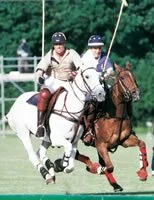 The first recorded game took place in 600 BC, between the Turkomans and Persians (the Turkomans won). The first recorded game took place in 600 BC, between the Turkomans and Persians (the Turkomans won).
In the 4th century AD King Sapoor II of Persia learned to play, aged 7. In the 16th century AD a polo ground (300 yards long and with goal posts 8 yards apart) was built at Ispahan, then the capital, by Shah Abbas the Great.
The Moguls were largely responsible for taking the game from Persia to the east, and by the 16th century the Emperor Babur had established it in India. (It had already long been played in China and Japan, but had died out by the time the west came in contact with those countries).
In the 1850s British tea planters discovered the game in Manipur (Munipoor) on the Burmese border with India. The first polo club in the world was formed by them at Silchar, west of Manipur. Other clubs followed and, today, the oldest in the world is the Calcutta Club, founded in 1862.
Malta followed in 1868, due to soldiers and Naval officers stopping off there on their way home from India. In 1869 Edward “Chicken” Hartopp, 10th Hussars, read an account of the game in The Field, while stationed at Aldershot, and with brother officers organised the first game - known then as “hockey on horseback” on a hastily-rolled Hounslow Heath. He drew up a short list of 9 or 10 rules; but it was John Watson (1856 - 1908), 13th Hussars, who formulated the first real rules of the game in India in the 1870s. He later formed the celebrated Freebooters team - who won the first Westchester Cup match in 1886 - and was a foremost player in the All Ireland Polo Club, founded in 1872 by Horace Rochfort of Clogrenane, Co. Carlow.
The first polo club in England was Monmouthshire, founded in 1872 by Capt. Francis “Tip” Herbert (1845 - 1922), 7th Lancers, at his brother’s seat, Clytha Park, near Abergavenny. Others, including Hurlingham, followed quickly. Handicaps were introduced by the U.S.A. in 1888 and by England and India in 1910.
The first official match in Argentina took place on 3rd September 1875, where the game had been taken by English and Irish engineers and ranchers.
In 1876 Lt. Col. Thomas St. Quintin, 10th Hussars, introduced the game to Australia - he was the “Father of Australian Polo” and two of his brothers stayed on there as ranchers and helped the game to develop.
In the same year, polo was introduced to the U.S.A. by James Gordon Bennett Jr, who had seen the game at Hurlingham while on a visit to England.
Today, upwards of 77 countries play polo. It was an Olympic sport from 1900 to 1939 and has now been recognised again by the International Olympic Committee.
Visit: Hurlingham Polo Association
Many thanks to Zahra Hanbury Photography for their quality photographs.
Please mention Sports 1 Link when contacting this sports association.
|